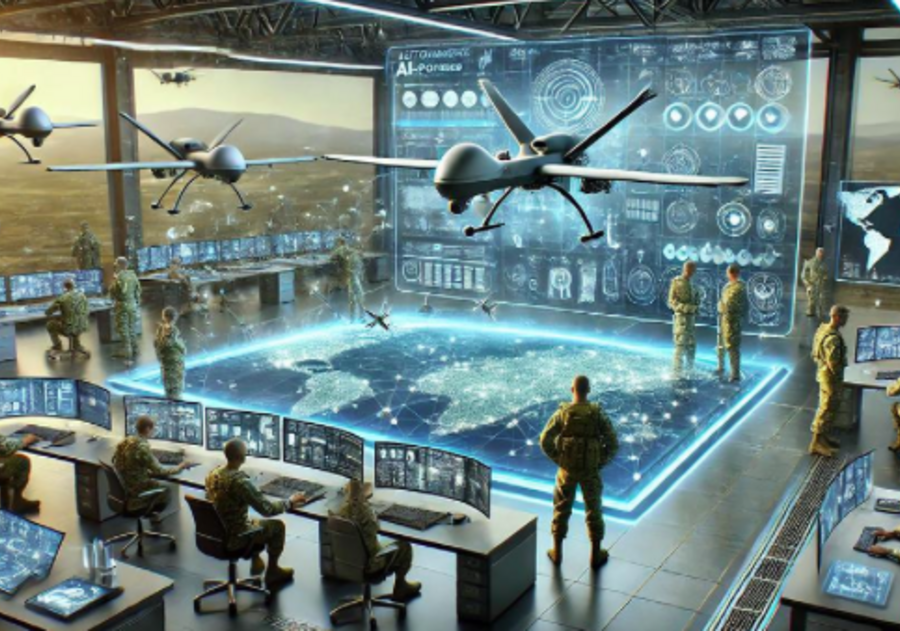
Artificial intelligence is fundamentally changing the speed, scale, and sophistication of modern warfare. One of the most significant transformations is occurring within the military's traditional "kill chain"—the sequence of steps required to identify, track, evaluate, engage, and assess a potential target.
What once required multiple human operators, separate intelligence systems, and lengthy decision-making processes can increasingly be supported by AI-powered technologies operating at extraordinary speeds.
For defense innovators, technology entrepreneurs, and investors, this transformation represents far more than an improvement in military efficiency. It signals the emergence of an entirely new generation of defense technologies, autonomous systems, advanced sensors, and AI-driven decision-support platforms.
Understanding the Traditional Military Kill Chain
The traditional military kill chain is commonly described through six stages:
Find → Fix → Track → Target → Engage → Assess
Each stage serves a distinct purpose, and historically, each has required substantial human involvement.
The critical distinction is that AI can significantly reduce the time required to process information at multiple stages without necessarily removing humans from the decision-making process.
The Biggest Breakthrough: Reducing Sensor-to-Shooter Time
One of the most consequential advantages of AI-enabled defense systems is the ability to compress what military strategists call sensor-to-shooter time, also known as sensor-to-effector time.
In traditional military operations, information frequently moves through a sequence of separate systems and personnel:
Sensor Detection → Data Transmission → Intelligence Analysis → Command Decision → Weapon Assignment → Authorization → Engagement
Depending on the mission, this process may take minutes or considerably longer.
AI-enabled architectures seek to simplify and accelerate this sequence:
Sensor Detection → AI Data Fusion and Classification → Human Decision and Authorization → Response
By rapidly integrating information from multiple sources, AI can reduce the delays between detecting a potential threat and determining an appropriate response.
The strategic advantage is not simply faster weapons deployment. It is faster understanding, better-informed decisions, and the ability to respond to rapidly changing conditions.
Importantly, the speed advantage depends on reliable data, effective communications, validated AI models, and appropriate human oversight.
From Individual Platforms to an Intelligent Defense Network
Perhaps the most transformative development is AI's ability to connect multiple military platforms into a coordinated information network.
Consider a modern operational environment involving fighter aircraft, unmanned drones, satellites, naval vessels, and ground-based radar systems.
Each platform may observe a different part of the same environment.
Traditionally, combining those observations into a coherent picture required substantial coordination and human analysis.
AI-enabled systems can increasingly perform this information-fusion process automatically.
For example:
A surveillance drone detects an unidentified object.
A ground-based radar system identifies a corresponding track.
A satellite provides additional observations.
AI correlates the information from all three sources.
The system produces a probable classification with supporting information.
Decision-support software evaluates possible responses.
Authorized personnel determine whether action is appropriate.
This capability is commonly associated with multi-sensor fusion, a rapidly advancing field with significant applications across defense, aerospace, intelligence, and national security.
The result is a shift from isolated platforms toward interconnected systems that can share information and support decisions at machine speed.
The Next Evolution: AI at Battlefield Scale
The next major transformation involves scale.
Human operators have natural limitations in their ability to monitor, analyze, and respond to hundreds or thousands of simultaneous events.
AI-enabled systems can potentially process vast numbers of sensor observations and maintain numerous tracks concurrently.
This creates opportunities for technologies such as:
Collaborative Combat Aircraft: Unmanned aircraft designed to operate alongside piloted platforms.
Autonomous Intelligence, Surveillance, and Reconnaissance (ISR): Systems that continuously collect and analyze operational intelligence.
AI-Enabled Air Defense: Networks that help identify, classify, and prioritize potential airborne threats.
Distributed Maritime Sensing: Connected naval and unmanned platforms sharing intelligence across large geographic areas.
Multi-Agent Autonomous Systems: Multiple unmanned systems coordinating activities within defined operational boundaries.
Human-on-the-Loop Command Systems: Architectures that allow human supervisors to monitor and intervene in certain automated operations.
The traditional model of one sensor supporting one operator and one response is evolving toward something substantially more sophisticated:
Multiple Sensors → AI Information Fusion → Multiple Potential Threats → Coordinated Decision Support → Available Response Systems
This shift has profound implications for military readiness, operational efficiency, and the future of defense technology.
Why This Matters to Investors and Entrepreneurs
For the investment community, the acceleration of AI-enabled defense capabilities creates opportunities across an expanding ecosystem of emerging technologies.
Importantly, many of the most promising innovations extend beyond weapons systems themselves.
1. Artificial Intelligence and Decision-Support Software
Companies developing AI systems capable of processing complex information, identifying patterns, and supporting time-sensitive decisions may find opportunities across defense, intelligence, cybersecurity, and commercial industries.
2. Advanced Sensors and Data Fusion
Technologies that integrate radar, imaging, satellite intelligence, and other sensor inputs are increasingly important to next-generation defense architectures.
3. Autonomous and Unmanned Systems
Advances in autonomous aircraft, maritime vehicles, robotics, and coordinated unmanned platforms are creating new markets for hardware, software, navigation, and control technologies.
4. Edge Computing and AI Infrastructure
Defense applications often require data to be processed near its source rather than transmitted to distant computing centers.
This creates demand for compact, energy-efficient processors, secure computing platforms, and AI systems capable of operating in challenging environments.
5. Secure Communications and Cybersecurity
As military systems become more interconnected, secure and resilient communications become essential.
Technologies that protect data integrity, prevent unauthorized interference, and maintain connectivity in contested environments represent important areas of innovation.
6. Testing, Validation, and Responsible AI
One of the most important emerging opportunities involves technologies that ensure AI systems operate reliably, predictably, and within established operational and legal boundaries.
For investors evaluating defense technology companies, technical innovation alone is not sufficient. Commercial adoption, procurement pathways, cybersecurity requirements, regulatory considerations, capital intensity, and the ability to demonstrate measurable performance are equally important.
The Critical Question: How Much Control Should AI Have?
Despite its extraordinary capabilities, AI does not eliminate the need for human judgment.
Some of the most difficult military decisions involve questions that cannot be resolved through processing speed alone:
Is the target correctly identified?
Does the proposed action comply with applicable rules of engagement and international humanitarian law?
Has the system accurately distinguished between military and civilian objects?
Who is responsible for authorizing and evaluating consequential decisions?
How reliable is the information supporting the recommendation?
AI systems can make errors, misclassify objects, or be affected by incomplete information, adversarial deception, and unexpected operating conditions.
These risks become especially consequential when decisions involve the potential use of lethal force.
The future of military AI will therefore depend not only on greater autonomy, but also on trustworthy systems, rigorous testing, clear accountability, and appropriate levels of human judgment and control.
The distinction matters: an AI-accelerated kill chain is not necessarily an autonomous weapons system.
The Broader Strategic Implications
AI-enabled defense systems are changing how nations think about deterrence, military preparedness, and technological competitiveness.
The ability to collect, interpret, and act upon information faster than an adversary can offer substantial strategic advantages.
However, faster decision-making also introduces new challenges, including the potential for misidentification, automation bias, unintended escalation, and overreliance on systems that may perform unpredictably under unfamiliar conditions.
Future military effectiveness will depend on balancing technological speed with decision quality, resilience, and accountability.
The most successful systems may not be those that operate with the least human involvement, but those that most effectively combine machine-speed information processing with informed human judgment.
A New Frontier for Angel Investing
At Keiretsu Forum Southern California, we recognize that some of the most consequential investment opportunities emerge when breakthrough technologies begin transforming established industries.
Artificial intelligence's growing role in defense represents one such transformation.
From autonomous platforms and intelligent sensors to advanced computing, secure communications, and decision-support software, a new generation of innovators is developing technologies with the potential to reshape national security and create substantial commercial value.
Many of these innovations also have dual-use applications across logistics, aerospace, manufacturing, emergency response, transportation, and critical infrastructure.
For angel investors, the opportunity is to identify companies with differentiated intellectual property, capable leadership, credible market demand, and a realistic path toward commercialization.
For entrepreneurs, the challenge is to translate technological breakthroughs into reliable, scalable solutions that address clearly defined operational needs.
The future of defense innovation is not simply about acting faster. It is about understanding more, deciding better, and connecting technologies in ways that were previously impossible.
As artificial intelligence continues to evolve, the companies enabling this transformation may help define the next generation of defense and dual-use technology.