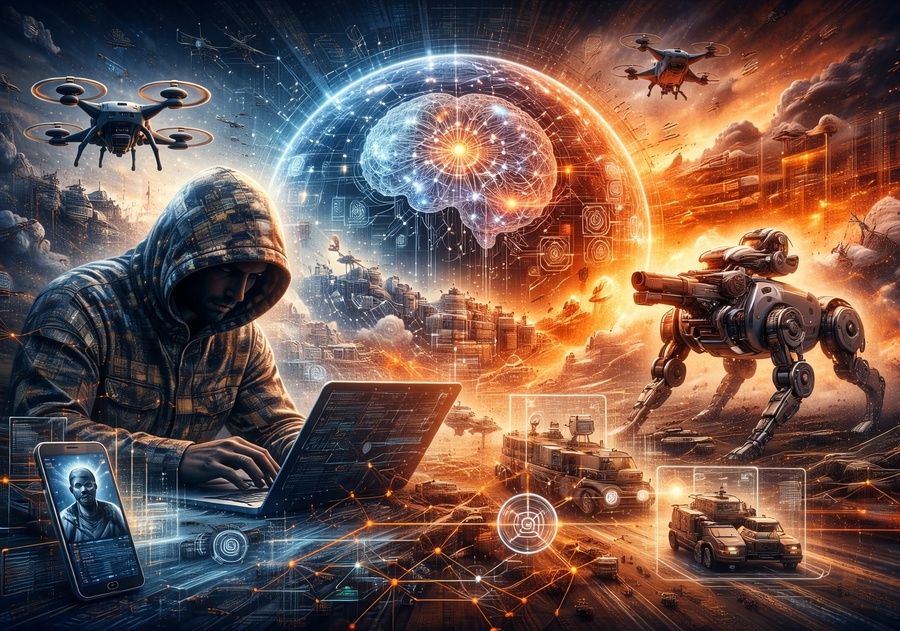
Artificial Intelligence as a Tool in Asymmetric Warfare
Asymmetric warfare—conflict between actors of vastly unequal power, resources, or conventional military capability—has long been shaped by innovation. Historically, weaker actors have offset disadvantages by exploiting unconventional strategies, local knowledge, or political leverage. Today, artificial intelligence (AI) has emerged as a transformative tool in this domain, altering the balance between state and non-state groups, expanding the battlespace into cyberspace, and reshaping how intelligence, influence, and operations are conducted. AI’s accessibility, scalability, and dual-use nature allow small groups to harness technologies once reserved for major governments, fundamentally shifting the character of modern asymmetry.
1. Information Advantage and Intelligence Gathering
One of the most significant ways AI enables asymmetric actors is by democratizing access to advanced intelligence tools. Machine learning algorithms now assist in collecting, sorting, and analyzing enormous volumes of open-source information. Non-state groups can leverage publicly available datasets, satellite imagery, and social media content to map troop movements, identify vulnerable infrastructure, and monitor political sentiment.
State actors, for their part, use AI-driven analytics to detect patterns associated with insurgent activity, anticipate ambushes, or identify clandestine networks. Natural language processing (NLP) tools help analyze intercepted communications or extremist propaganda at a scale previously impossible. This information advantage is particularly crucial in counterinsurgency, where distinguishing civilians from combatants often determines the success of an operation.
Furthermore, AI-assisted geospatial analysis—once the domain of major intelligence agencies—is now feasible for smaller groups using commercial platforms. This levels the field: even actors with limited budgets can track convoy routes, assess terrain advantages, or time operations with precision.
2. Increasing Autonomy and the Evolution of Weaponry
AI is accelerating the development of autonomous and semi-autonomous weapons, from loitering munitions to small quadcopters equipped with computer vision. These systems offer high-impact, low-cost capabilities ideally suited to asymmetric actors. A $500 drone enhanced with AI-based target recognition can threaten million-dollar armored vehicles, flipping the traditional cost-exchange ratio in warfare.
Insurgent groups and militias are increasingly capable of:
- Automating swarm attacks, overwhelming defenses with dozens of inexpensive drones.
- Guiding improvised explosive devices (IEDs) using computer vision to identify targets without constant human control.
- Using AI for flight stabilization, path planning, and object detection, enabling more precise strikes.
This arms race introduces ethical and strategic challenges: the more widely available AI becomes, the more likely it is to fuel escalatory cycles and blur the line between civilian and combatant technology.
3. Cognitive Warfare and Influence Operations
AI is also reshaping the informational front of asymmetric warfare. Influence operations—once labor-intensive—now scale rapidly through automated content generation and micro-targeting. Non-state groups leverage AI to:
- spread propaganda through deepfakes, fabricated news, or AI-generated speeches;
- tailor narratives to specific audiences using sentiment analysis;
- create bots that simulate widespread public support or dissent.
State actors also rely on AI to counter these campaigns. Machine-learning models detect bot networks, classify manipulated media, and map influence operations across platforms. However, disinformation detection often lags behind creation; thus, asymmetric groups frequently gain the initiative by exploiting the speed and anonymity AI affords.
4. Cyber Operations Enhanced by AI
Cyber warfare is inherently asymmetric: a small, skilled team can cause outsized damage to a large military power. AI amplifies this dynamic by automating tasks such as vulnerability discovery, phishing generation, traffic analysis, and intrusion detection evasion.
AI-trained malware can:
- adapt to defensive measures in real time,
- hide in normal network traffic more effectively,
- identify valuable targets autonomously.
Governments counter with AI-driven cybersecurity tools that analyze behavior rather than signatures, predicting attacks before they unfold. This creates a constant competition between offensive and defensive AI systems, each learning from the other in a fast-evolving digital battlefield.
5. Logistics, Training, and Organizational Efficiency
For both state and non-state actors, AI enhances internal capabilities that were once difficult to scale. Machine learning supports:
- logistics optimization, helping insurgents better coordinate decentralized cells or allowing militaries to manage supply chains in hostile terrain;
- simulated training environments, enabling fighters to practice tactics virtually without revealing themselves physically;
- resource management, such as allocating manpower or synchronizing attacks based on predictive analytics.
6. Ethical and Strategic Implications
The use of AI in asymmetric warfare raises profound questions:
- Lowered barriers to entry mean sophisticated capabilities can fall into the hands of terrorist groups or rogue militias.
- Autonomy reduces accountability, complicating international law and rules of engagement.
- AI-driven escalation may lead to rapid, automated cycles of attack and retaliation.
- Civilian technologies are militarized, making regulation more challenging.
In conclusion, artificial intelligence has become a decisive force multiplier in asymmetric warfare, empowering weaker actors while challenging stronger ones to defend against increasingly sophisticated and unpredictable threats. From intelligence analysis to autonomous weaponry, influence operations, and cyber capability, AI is not merely an enhancement—it is redefining asymmetry itself. As we move deeper into the 21st century, mastering the risks, ethics, and strategic implications of AI will be essential to maintaining stability in a world where conflicts are no longer fought on equal terms.

The real revolution in supply chains isn’t speed—it’s intelligence. AI now anticipates demand, na...
Evolution used to take millennia. Now it takes minutes.Artificial intelligence is reshaping how h...